

Two New Publications by Zaroui Pogossian Offer Insights into Medieval Armenia
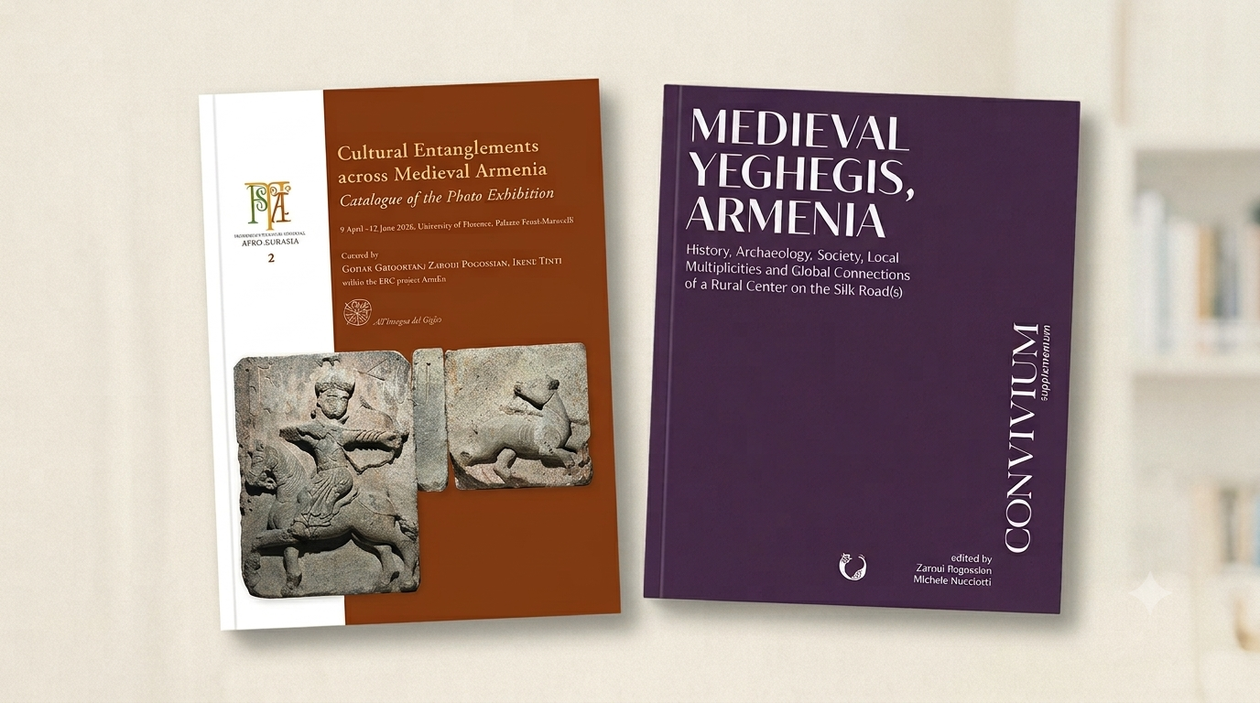
The exhibition catalog “Cultural Entanglements across Medieval Armenia,” edited by Zaroui Pogossian together with Gohar Grigoryan and Irene Tinti, accompanies the closing exhibition of the ERC-funded project “Armenia Entangled – Connectivity and Cultural Encounters in Medieval Eurasia (9th–14th Century).” Aimed at a wider public beyond academia, the publication was released at the conclusion of the project’s funding period and presents 27 case studies that illustrate the diverse cultural encounters in medieval Armenia through manuscripts, inscriptions, coins, architecture, works of art, and everyday objects. The selected specimens illustrate processes of exchange between different religious, linguistic, and political communities and make the project’s transcultural research approach accessible to a broader public.
Armenia Entangled developed a new research framework that conceives of Armenia and the neighboring regions of the South Caucasus, Anatolia, and Northern Mesopotamia as a polycentric space of intense cultural interconnections between the 9th and 14th centuries. CERES was the partner institution of this ERC project, with Prof. Dr. Alexandra Cuffel as the PI oft he CERES component. She examined medieval epics and narrative traditions with a particular focus on women as cultural mediators between religious and ethnic groups. She has also contributed on revealing early medieval Jewish sources‘ geographical knowledge and conceptions about Armenia. Dr. Barbara Roggema researched previously under-explored Arabic and Syrian sources on the relationships between Armenian, Syriac, and Muslim communities. Together with Zaroui Pogossian, she analyzed, among other things, a Jewish-Christian-Muslim debated attributed to Abraham of Tiberias—preserved in Arabic and later translated into Armenian—as well as Armenian sources on the Prophet Muhammad. Both scholars also made a significant contribution to the development of the project’s theoretical framework.
The anthology „Medieval Yeghegis, Armenia“, edited by Zaroui Pogossian and Michele Nucciotti, presents the results of many years of interdisciplinary research on the medieval settlement of Yeghegis. The volume builds upon and further develops research that began in the ERC project JewsEast with the investigation of the medieval Jewish cemetery at Yeghegis. Contributions from archaeology, history, and cultural studies trace Yeghegis as a regional center that was closely integrated into the trade, mobility, and communication networks of medieval Eurasia. The contributions illustrate how local developments and large-scale political and cultural processes influenced one another, and how even smaller settlements became hubs of cultural encounters.
The two new publications also reflect Zaroui Pogossian’s longstanding connection to CERES. From 2015 to 2020, she served as a research associate on the ERC project JewsEast, which, among other things, served as the starting point for her research on the medieval Jewish cemetery in Yeghegis. In addition, she was previously a fellow at CERES’s Käte Hamburger Kolleg Dynamics of Religious History between Asia and Europe. With Armenia Entangled, she continued her collaboration with CERES and worked closely with the Bochum-based religious studies scholars Prof. Dr. Alexandra Cuffel and Dr. Barbara Roggema. The two publications thus also represent a scholarly collaboration that has developed over the course of several research projects.