

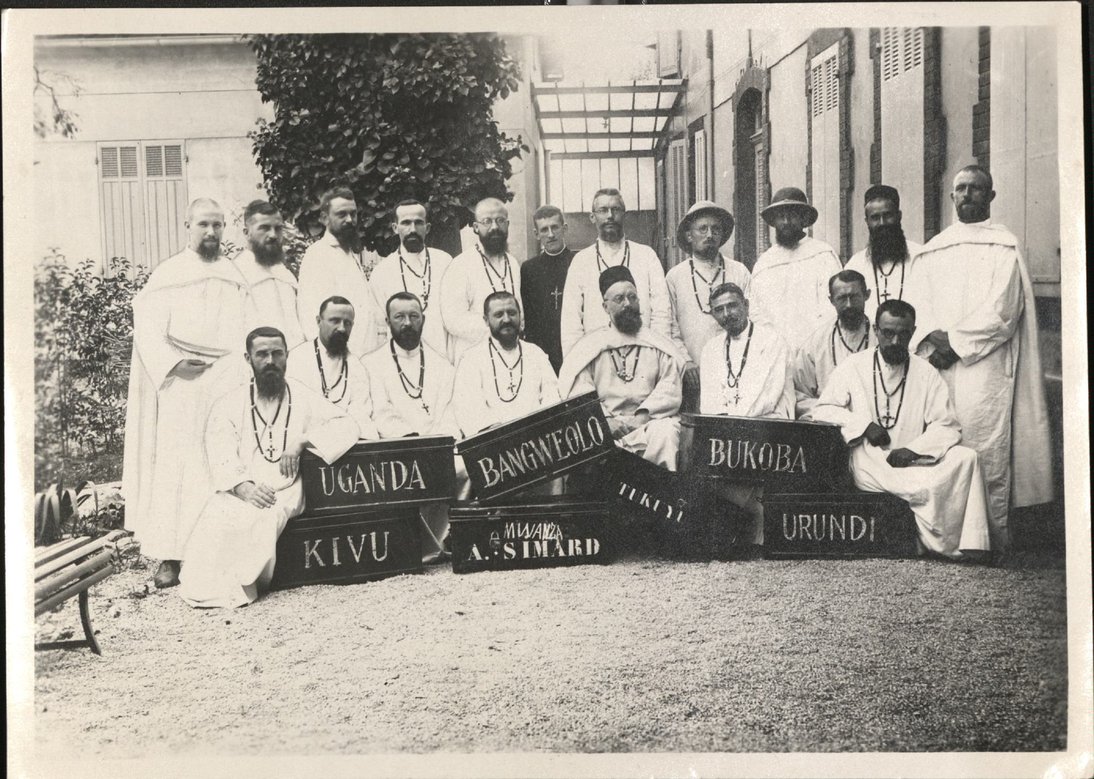
New Research Project Examines “Networks of Missionary Collecting”
These questions are the focus of the new research project “Networks of Missionary Collecting: On the Provenance of the Collections of the African Missionaries—Weiße Väter e.V.,” which will begin on July 1, 2026, at the Center for Religious Studies (CERES) at Ruhr University Bochum. The two-year project is funded by the German Center for Lost Cultural Property. The project will examine these questions using the collecting activities of the Catholic missionary society of the African Missionaries—colloquially known as the “White Fathers”—as a case study. Since its founding in 1878, the missionary society has been active in many countries in sub-Saharan Africa. In the course of its work in Africa, numerous artifacts found their way to Europe. Today, these collections serve as important sources for researching the history of both the countries of origin and the former colonial powers.
The project focuses on the networks of missionary collecting and aims to demonstrate that missionaries did not act in isolation, but were embedded in complex relationships with local communities, colonial administrations, and other actors. These interconnections significantly shaped which objects were collected, the routes by which they reached Europe, and how they were interpreted in new contexts. With this network-oriented approach, the project contributes to foundational and contextual research in provenance studies. By reconstructing missionary collecting as a complex social and historical process, it aims to open up new perspectives on collections from colonial contexts. In particular, it seeks to highlight that the collecting activities of missionaries were the result of multilateral relationships and transnational exchange processes. With this approach, the project builds on previous research findings from the “Mission Collections” research focus at CERES.
Project Director Dr. Martin Radermacher explains:
“The collecting activities of missionaries were always embedded in complex networks that, to this day, have scarcely been understood or reconstructed. This project is conceived as foundational and contextual research intended to enrich the discourse on provenance research, particularly in sub-Saharan Africa.”
The project is funded by the German Center for Lost Cultural Property, which supports research projects on the provenance of cultural property. A key focus of this work is the study of collection items from colonial contexts. The goal of this funding is to establish a scholarly foundation for the transparent and responsible handling of cultural property and to strengthen international collaboration in provenance research.