

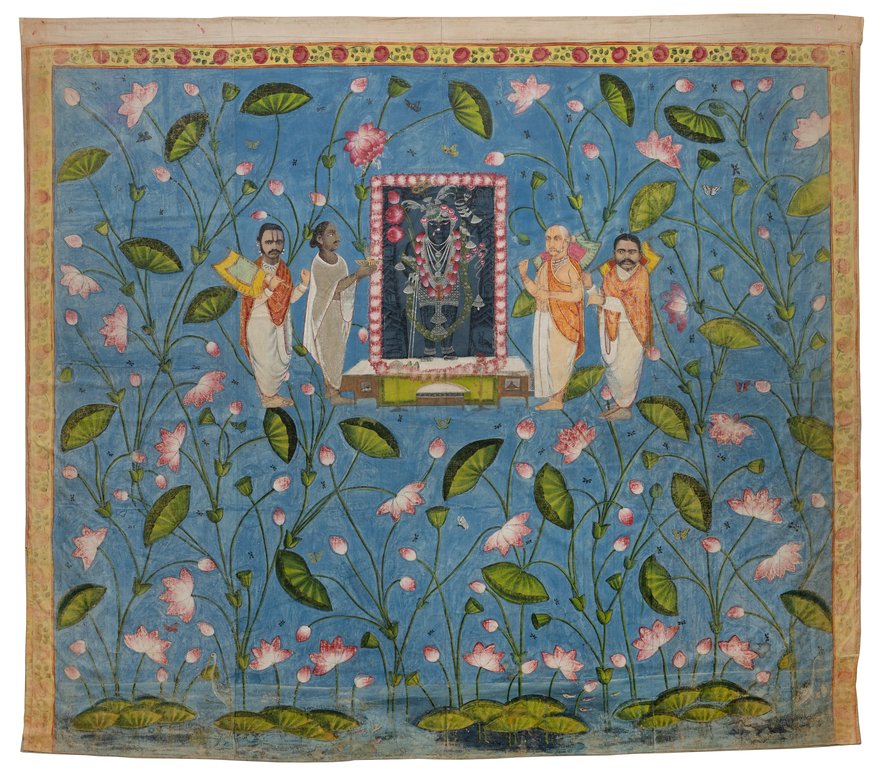
Interview with Dr. Patrick Felix Krüger on the exhibition “Krishna – Religion, Art and Pop Culture”
Dr. Krüger, as part of the Lucian Scherman Lecture at the Museum Fünf Kontinente, you ask whether and how religions can be exhibited. What led you to this fundamental question—and to what extent do your curatorial experiences inform your lecture?
Dr. Patrick Krüger: This question has preoccupied me for a long time because, in my curatorial practice, I repeatedly encounter a limit: Religion is something lived, something experiential—the museum, on the other hand, creates a space for observation, classification, and distance. This tension became particularly palpable while working on the Krishna exhibition at the Museum Fünf Kontinente. My lecture is an attempt to reflect precisely on these experiences: What happens when we exhibit religion—and what inevitably eludes us in the process?
Your upcoming Krishna exhibition at the Museum Fünf Kontinente is designed as a large-scale exhibition, comparable to a project in Zurich a few years ago. How do curatorial strategies for dealing with religious objects change when the scale of an exhibition increases?
Dr. Patrick Krüger: Working on a larger scale changes the nature of the work significantly. I can no longer simply let individual objects speak for themselves; instead, I must develop a complex narrative. This means more context, more voices, and more levels of interpretation. Especially with religious objects, it is important that they do not appear in isolation as mere “beautiful things,” but rather can be experienced within their broader contexts of meaning.
Your lecture explores the tension between cult, art, and the museum: How does the meaning of religious objects change when they are transferred from ritual contexts to museum presentations—and what role does the specific exhibition practice play in this, for example in a project like your Krishna exhibition?
Dr. Patrick Krüger: The transfer to the museum signifies a transformation: an object shifts from being a bearer of ritual presence to an exhibit. This shift cannot be reversed, but it can be reflected upon. In exhibition practice, we attempt to make this difference visible—for example, through references to usage, through the voices of practitioners, or through elements that at least hint at the original context.
You describe a convergence between religious spaces and museums—churches are becoming more museum-like, while museums are increasingly adopting a sacred atmosphere. What cultural or social dynamics are driving this trend?
Dr. Patrick Krüger: This development reflects a profound social shift: For many people in European societies, religion is losing its institutional ties, while the need for meaning and spirituality often remains. At the same time, churches are opening up culturally and becoming places of education and art, for example through concerts or as tourist attractions. Museums, in turn, increasingly seek not only to present objects but also to reveal their backgrounds and contexts of use. Thus, both institutions are unwittingly moving toward one another, as they address similar needs of a secular, searching society.
These dynamics are particularly evident in the examples of Hinduism and Buddhism. Since your exhibition is also situated within the context of Hindu traditions: What makes these religious contexts so particularly illuminating for your research question?
Dr. Patrick Krüger: These traditions are particularly revealing because they have a long history of visual and material culture in which objects are actively integrated into ritual processes. At the same time, diverse forms of appropriation exist in a global context. I am particularly interested in these traditions because objects often play an active role in religious life within them. They are not merely symbols, but part of a practice. At the same time, they circulate globally and are interpreted in different ways.
To what extent is there a risk that religious artifacts in the museum will be aestheticized or even stripped of their original meaning—and how do you try to counteract this in your own curatorial practice, for example in the Krishna exhibition?
Dr. Patrick Krüger: The aestheticization of religious artifacts is a real danger—especially in Western exhibition contexts. We try to counteract this by making contexts visible and incorporating perspectives that go beyond a purely aesthetic view. For me, the key point is this: the objects should not merely impress, but be understood. The goal is to present the objects not only as “beautiful,” but also as “meaningful.”
Where do you see the limits of how religion can be represented in a museum? Are there aspects of religious experience that are fundamentally beyond the scope of an exhibition—even in a large-scale presentation with an accompanying catalog?
Dr. Patrick Krüger: I believe there are clear boundaries. Certain aspects of religion—such as personal experience or transcendence—cannot be exhibited. And perhaps it is also important to acknowledge this boundary. The museum can create points of connection, but it cannot provide a complete translation. Certain aspects are fundamentally beyond the scope of an exhibition. Museums cannot reproduce these dimensions, but can only convey them indirectly. This boundary is not a shortcoming, but an important point of reflection in curatorial work.
At the same time, museums are increasingly opening up to religious practices, while religious sites are adapting exhibition logic. Does this also give rise to new formats that you are exploring in your curatorial work?
Dr. Patrick Krüger: The convergence of museums and religion is giving rise to new hybrid formats: participatory installations, performative elements, or spaces of experience. We tested such approaches a few years ago with the interactive knowledge game “And You? The Game of Questions” in the exhibition “Being Jain” at the Museum Rietberg. The game, with its room-filling playing area, encouraged exhibition visitors to shift perspectives and explore new ways of thinking. It is based on the game “Gyan Chaupar,” which served as a teaching tool for various religious groups in India in the early 19th century.
Instead of a traditional exhibition catalog, an accompanying volume is being published alongside the exhibition. What role does such a publication play today—more as an academic exploration, as a standalone medium, or even as an extension of the exhibition space?
Dr. Patrick Krüger: Many museums today are foregoing extensive exhibition catalogs because such publications no longer sell well. Yet exhibition catalogs are far more than a mere documentation of the exhibited works. They represent an independent medium that allows for a deeper exploration of content that can only be hinted at in the exhibition space. At the same time, they offer space for different voices and perspectives to coexist. In this sense, catalogs function as an extension of the exhibition space and—as André Malraux has shown—can also be understood as a kind of metaphor for the exhibition. For the Krishna exhibition, we opted instead for an accompanying volume that can also be read independently of the exhibition.
What do you hope your audience will perceive differently after the lecture—and perhaps also after visiting the Krishna exhibition—when they encounter religious objects in the museum in the future?
Dr. Patrick Krüger: Ideally, visitors will leave the lecture and the exhibition with a heightened sense of awareness: I would hope that visitors reflect more deeply on their own perspectives. That they see religious objects not merely as works of art, but as part of living traditions. And perhaps also that they become more attuned to what is visible in the museum—and what remains invisible.
Thank you very much for the interview!
Event Announcement
The exhibition “Krishna – Religion, Art and Pop Culture” runs from 24 April to 8 November 2026 at the Museum Fünf Kontinente in Munich. Dr. Patrick Felix Krüger’s lecture will take place on May 12, 2026, at 6:00 p.m. as part of the Krishna exhibition at the Museum Fünf Kontinente in Munich. For more information, visit https://ceres.rub.de/de/events/lucian-scherman-lecture-religionen-ausstellen-ein/.