

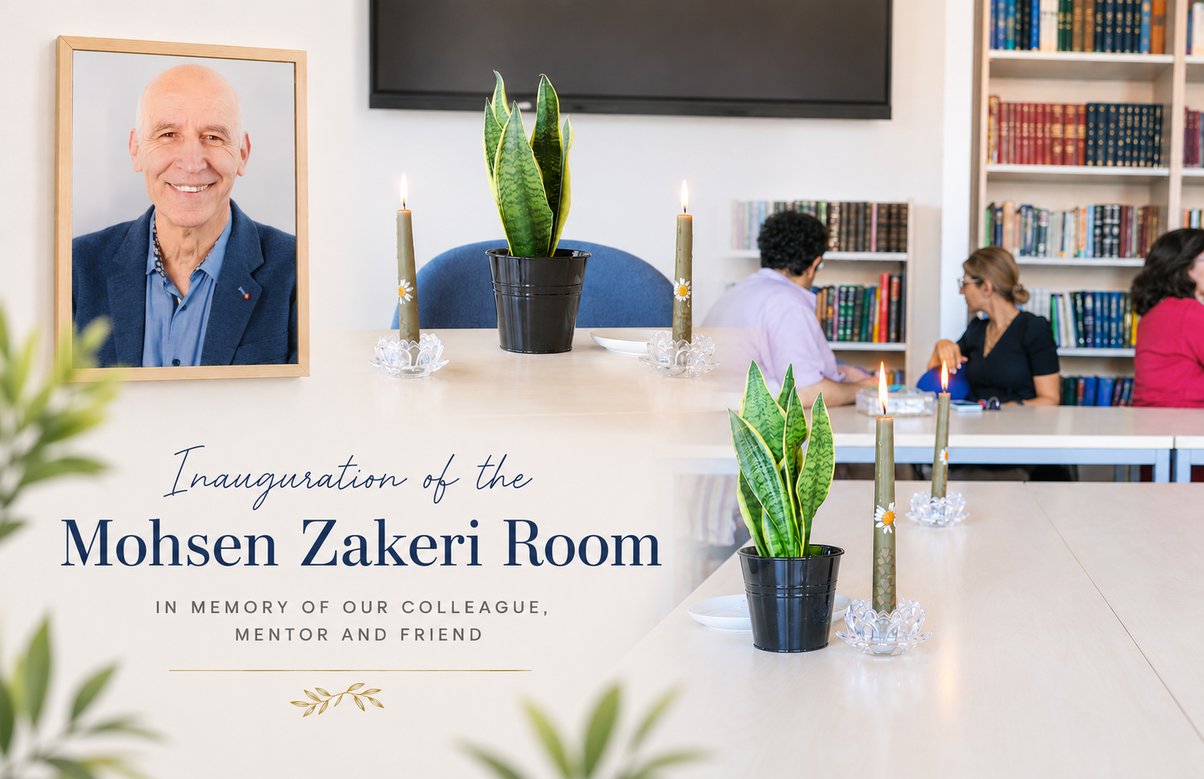
Inauguration of the Zakeri Room
The dedication ceremony was attended by colleagues and friends who gathered to commemorate Mohsen Zakeri's academic contributions and his lasting impact on the CERES community. As a permanent tribute, the room now bears his name and houses a small reference library containing a selection of his personal and scholarly books, making his work accessible to future generations of researchers and students.
At the time of his passing, Dr. Zakeri was conducting research at CERES on the project "How Sasanian Knowledge and Literature Were Transmitted to Muslims: A Reassessment of Cultural Transfer through Translation in Late Antiquity." His work focused on the transmission of knowledge between the Sasanian and early Islamic worlds and made an important contribution to the study of intercultural exchange in Late Antiquity.
Dr. Mohsen Zakeri held two bachelor's degrees, one in Literature and the other in Psychology and Anthropology. He continued his postgraduate studies in Near Eastern Studies at the University of Washington before completing his Ph.D. in History at the University of Utah in Salt Lake City.
Following the completion of his doctorate, he worked as a research associate at the Institute of Oriental Studies at Martin Luther University Halle-Wittenberg and at Friedrich Schiller University Jena between 1994 and 1999. Supported by grants from the German Research Foundation (DFG), he subsequently pursued research at Goethe University Frankfurt on the role of ʿAlī Ibn ʿUbaida al-Raiḥānī (d. ca. 219/834) as a mediator of Iranian and Greek intellectual traditions to Islamic culture. He later continued his research at the University of Göttingen, where he worked on the project "The 'Wise' Ruler: Mirrors for Princes in Persian and Early Islamic Arabic Literature." In 2014, he served as substitute professor of Islamic Studies at the University of Göttingen.
Among his most significant scholarly achievements was the completion of the edition, translation and commentary of Persian Wisdom in Arabic Garb, a work that was honoured with the Book Prize of the Year of Iran in 2009.
The inauguration of the Zakeri Room stands as a lasting expression of appreciation for Mohsen Zakeri's scholarship, generosity and collegiality. By preserving both his name and part of his academic legacy within CERES, the room will continue to inspire research, dialogue and learning in the years to come.